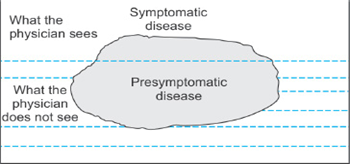
Ice-Berg of disease
The concept closely related to the spectrum of disease is the iceberg phenomenon. According to this concept, disease in a community can be likened to an iceberg. The visible tip of the iceberg represents what physicians observe in the community—clinical cases. The vast submerged portion of the iceberg signifies the concealed mass of disease, including latent, inapparent, pre-symptomatic, and undiagnosed cases, as well as carriers within the community. The “waterline” marks the boundary between apparent and inapparent disease.
In certain conditions such as hypertension, diabetes, anemia, malnutrition, and mental illness, the unknown morbidity (i.e., the submerged portion of the iceberg) often surpasses the known morbidity. The concealed part of the iceberg serves as a crucial, undiagnosed reservoir of infection or disease in the community, posing a challenge to modern preventive medicine techniques. A significant obstacle in studying chronic diseases of unknown etiology is the lack of methods to detect the subclinical state the bottom of the iceberg.
Fig. Ice-Berg of disease
Sources: Park, K. (2021). Park’s Textbook of Preventive and Social Medicine (26th ed.). Bhanot Publishers.
Additional link: Click here