Excreta disposal
Introduction
Human excreta refers to all excretory discharges, such as urine and stool, from human bodies. Human excreta is a significant source of infection, especially for the gastrointestinal system, and is a major contributor to environmental pollution. Improper excreta disposal can lead to health hazards, including soil pollution, air pollution, water pollution, and contamination of food.
Every society bears the responsibility for the safe removal and disposal of human excreta to prevent harm to people. Diseases resulting from improper disposal include typhoid and paratyphoid fever, dysentery, diarrhea, cholera, worm infestation, viral hepatitis, and other similar intestinal infections. Various methods of excreta disposal should be clearly understood by community health nurses, as this is an essential health promotion measure. They need to advocate for preventing communicable diseases.
Transmission of faecal – oral disease
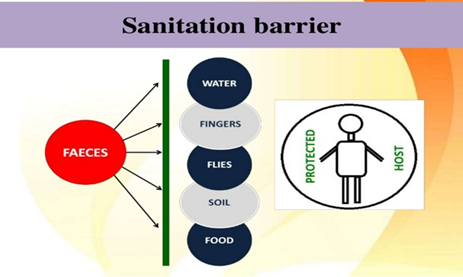
The transmission of faecal-oral diseases primarily centers around the human excreta of a sick or carrier person, as it contains the disease agent that is transmitted to a new host through various channels such as water, fingers, flies, soil, and food. The current approach in community medicine and community nursing aims to break the disease cycle at a crucial point. Although the disease cycle can be disrupted at various levels, including the segregation of faeces, protection of water supplies, safeguarding food, maintaining personal hygiene, and controlling flies, the most effective measure is to segregate faeces and ensure proper disposal. This process, known as the “sanitation barrier,” is primarily achieved through the use of sanitation latrines.
Methods of excreta disposal
- Service type/conservancy system
- Non service type/sanitary latrine
- Bore hole latrine
- Dug well or pit latrines
- Water seal type of latrines
- Septic tank
- Aqua privy
- Chemical closet
- Trench latrine (Shallow and deep trench latrine)
3. Water carriage system and sewage treatment
4. Ecological sanitation (Ecosan) toilet
- Service type or conservancy system
The collection and removal of night soil from a bucket or pail latrine by human agency is referred to as the service type or conservancy system. Night soil is transported in “night carts” to the place of final disposal, either by burial or composting. However, this system has numerous drawbacks as it contributes to the disease cycle, posing risks to human health and sanitation.
Disadvantages
- Unhygienic and unethical handling of night soil by workers.
- Exposure to flies at home, during transportation, and in the bucket where it is deposited.
- Dependence on a large number of sweepers; if they fail to come or go on strike, the entire system may collapse, causing significant disturbance to people’s health.
- Corrosion of buckets and pans, necessitating frequent replacement.
- Unsatisfactory emptying methods.
- Potential breeding of fecal-borne diseases in the community.
In 1949, the Environmental Hygiene Committee recommended replacing this insanitary service latrine with a non-service type of latrine.
2. Non-service type or sanitary latrine
The non-service type or sanitary latrine encompasses various types suitable for small-sized families, small groups of people, and camps. The choice of latrine in a community depends on factors such as finances, the number of members in a household, available area, water facilities, etc. Sanitary latrines must meet specific criteria known as the criteria of a sanitary latrine, including:
- Excreta should not contaminate the ground or surface water.
- It should not contaminate the surface soil.
- It should not be accessible to flies, rodents, animals, and other channels of transmission.
- It should be free from odour and have an unsightly appearance.
- It should be simple, cheap, and easy to operate.
- Borehole latrines
The non-service type or sanitary latrine, first introduced by the Rockefeller Foundation in 1930 during the hookworm control campaign, consists of a circular hole with a diameter of 12-16 inches and a depth of 20 feet, excavated in the earth using an “Auger machine.” The hole is lined with special bamboo and earthenware rings to prevent excreta from percolating into the soil. It includes a concrete squatting plate with a central opening and footrest, and a superstructure for privacy.
The latrine has a duration of 1-2 years, depending on the type of soil and the number of family members. Once the hole is nearly full, it is closed with earth, and the squatting plate is removed for reuse. A new hole is then dug for further use. The night soil undergoes purification through anaerobic digestion, ultimately converting it into a harmless mass.
Advantages
- It is cost-effective and well-suited for rural areas.
- Construction does not require skilled labor.
- The dark pit is unsuitable for fly breeding.
- It is located 50 feet away from water sources, minimizing the risk of water pollution and unpleasant odours.
Disadvantages
- The pit fills up rapidly due to its small capacity.
- Construction requires a specialized tool, the “Auger,” which may not be readily available.
- In certain locations, where subsoil water is high and the soil is loose, digging a hole deeper than 3 meters (10 feet) can be challenging.
ii. Dug well latrine/Pit latrines
The dug well latrine, first introduced in Singur, West Bengal, in 1949-50, is similar to a borehole latrine but represents an improvement. In this latrine, the pit’s diameter is 30 inches, and the depth ranges from 10 to 20 feet (3-3.5 meters). The pit is typically lined with pottery rings to prevent soil caving in. A concrete squatting plate is placed on top of the pit, and the latrine is enclosed with a superstructure.
This type of latrine has a greater capacity and can be used for a long duration, approximately 5 years, accommodating a number of 4-5 persons. Once filled, a new pit is dug. The action of the dug well latrine is similar to that of the borehole latrine, involving anaerobic processes.
Advantages
- Easy construction without the need for special equipment like an auger.
- Longer duration compared to the borehole latrine.
- Can be constructed using local resources.
- The dark environment is not conducive to fly breeding.
Disadvantage
It requires enough land.
iii. Water Seal Latrine
This improved device represents a significant advancement in the design of sanitary latrines suitable for rural areas. It is a “hand-flushed water seal” type of latrine that prevents the breeding of flies through the use of a trap, a small water container in a bent pipe and eliminates the escape of odours and foul gases. Once the night soil is flushed with water, it becomes no longer visible. Due to these qualities, this type of latrine has gained popularity in rural areas.
There are two types of water seal latrines:
a. PRAI, evolved by the Planning Research and Action Institutes, Lucknow.
b. RCA type, designed by the Research Cum Action project of Environment Sanitation of the Ministry of Health.
Of these two types, the RCA latrine has been commonly used and is also a suitable design for the country. The details of its parts and structure are described below:
i. Location: It should be situated at least 50 feet away from the water supply source and at a lower elevation to prevent water supply contamination. Areas prone to flooding should be avoided.
ii. Squatting plate: This is a crucial part of the latrine, made of cement concrete with raised footrests. The plate should measure a minimum of 3 feet square and 2 feet thickness at the outer edge, with a slope of ½’’ (0.5 inches) towards the pan.
iii. Latrine pan: The pan receives night soil, urine, and wash water. The front portion is 5 inches wide, the length is 17 inches, and the width at its widest portion is 8 inches. The pan has a uniform slope from the front to the back.
iv. Trap: The 3’’ (3 inches) diameter trap is a bent pipe connected to the pan, holding water as a seal to prevent fly breeding and suppress odors. The water seal depth in the RCA type latrine is ¾’’.
v. Connecting pipe: When the pit is dug away from the squatting plate, the trap is connected to the pit by a 3-foot-long, 3’’ diameter connecting pipe with a bend at the end.
vi. Footrests: Footrests are on either side of the pan.
vii. Dug well: The pit, usually 75 cm (30’’) in diameter and 3-3.5 m (10-12 ft.) deep, is covered. In loose soil and areas with a high water table, earthenware rings or bamboo matting can prevent pit caving. When one pit fills up, a second pit is dug nearby, and the connecting pipe’s direction is changed. After the second pit fills up, the first can be emptied and reused.
viii. Superstructure: A desired type of superstructure may be provided for privacy and shelter.
ix. Maintenance: Maintenance is crucial for this type of latrine. Proper usage should be taught, including flushing the pan with an adequate quantity of water. The squatting plate should be washed frequently and kept clean and dry.
Advantages
- It is cheap, sanitary, and long-lasting.
- It is suitable for rural areas where sweepers are not available.
- A minimal amount of water is required to remove human excreta.
- The water seal, filled up with the squatting plate, imparts the characteristics of a sanitary latrine.
iv. Septic tank
The septic tank is a watertight masonry (concrete) tank designed for the treatment of household sewage. It serves as a means of disposing of excreta and liquid waste from individual houses or small groups of dwellings that lack access to a public sewage system. The tank consists of two chambers connected with a water closet, where sewage is retained under favorable conditions for decomposition through anaerobic methods. The design considerations for a septic tank are outlined below:
- Capacity: The tank’s capacity depends on the number of users, typically ranging from 2.5 to 5 cubic feet.
- Length: Rectangular in shape, with a length twice its breadth, which is 5-7 feet.
- Depth: A depth of 5-7 feet (1.5-2 meters), with a liquid depth of only 1.2 meters (4 feet).
- Air space: A minimum air space of 30 cm (12 inches).
- Inlet and outlet: Inlet and outlet pipes are submerged.
- Bottom: Some tanks have a bottom sloping towards the inlet end, facilitating the retention of solids.
- Cover: Covered by a concrete slab of suitable thickness with a manhole.
- Retention period: Designed to allow a retention period of 24 hours.
- Maintenance: Avoid throwing soap water and disinfectants like phenol into the tank, as they can destroy the bacterial flora. The tank should be opened, and sludge removed annually.
Working of a septic tank involves four stages:
- Solid fecal matter settles at the bottom to form sludge, while light solids like grease and fat rise to the surface to form scum.
- Anaerobic bacteria decompose and digest solid fecal matter into single chemical compounds.
- Fecal matter is reduced in volume, converted into gases (mainly methane), sludge, and inoffensive effluent.
- The effluent, containing bacteria, yeast, ova, and organic matter, should not be discarded into the river without further purification.
The tank is divided into two chambers: a “grit chamber” and the actual septic tank (digestion chamber). The two chambers are connected by a ventilation pipe (12-18’’). The tank includes a manhole and a concrete slab cover.
The purification process involves two stages: anaerobic digestion in the septic tank and aerobic oxidation outside the tank in the subsoil. In the first stage, anaerobic bacteria break down solid masses into a fine suspension. The second stage involves aerobic bacteria in the soil oxidizing organic matter into stable end products, including carbon dioxide, nitrates, and water.
For efficient septic tank operation, five essential requirements must be maintained:
- Abundant water to carry excreta to the tank.
- Adequate space between the scum and the cover plate.
- Ventilators in both the grit chamber and the septic tank.
- Regular removal of sludge.
- Avoidance of disinfectants as they are harmful to bacterial flora in the tank.
v. Aqua privy
The aqua privy operates similarly to septic tanks. It consists of a watertight chamber filled with water, and a short length of a drop pipe from the latrine floods dips into the water. The tank’s shape may be circular or rectangular, with the size depending on the number of users. A recommended capacity of one cubic meter is suitable for a small family, allowing for 6 years or more before cleansing is required.
Night soil undergoes purification through aerobic digestion. As gases evolve during this process, ventilation is necessary for the release of gases into the atmosphere. However, the vent should be open above the roof of the dwelling. The effluent produced is not harmful and contains finely divided fecal matter in suspension, possibly carrying parasitic and infective agents. Similar to a septic tank, the effluent should be treated through subsoil irrigation or absorption. The digested sludge accumulating in the tank should be removed at intervals.
vi. Chemical closet
The chemical closet comprises a metal tank containing a disinfectant fluid, with formaldehyde and quaternary ammonium compounds as active ingredients. Typically, a harmless water dye and deodorizing substances are also incorporated. A seat with a cover is positioned directly over the tank, and it is important to note that only toilet paper should be disposed of in the chemical closet.
vii. Trench latrine
- Shallow trench latrine: It is suitable for temporary camps, fairs, or festivals, measuring 6-10 feet in length, 3-5 feet in depth, and 10-12 inches in width. The length varies based on the number of users. Users are instructed to cover feces with earth after defecation, and water for anal washing should be provided. A superstructure is constructed for privacy. Gammexane is used to minimize fly nuisance and bad smells. Separate facilities for males and females are recommended. When the trench is 1/3 full, it should be covered with earth and compacted. The excreta undergoes purification through aerobic bacteria.
- Deep trench latrine: This type is utilized for camps of longer duration, ranging from a few weeks to a few months. The trench is 6-8 feet deep and 30-35 inches wide, with a provided squatting plate. A superstructure is constructed for privacy. Other requirements are the same as for a shallow trench.
3. Water carriage or sewerage system
Water carriage systems or sewerage systems collect human excreta and wastewater from residential, commercial, and industrial areas through an underground network of drains known as sewers. These systems transport the waste to a designated disposal site. In Nepal, most municipalities and pre-planned urban areas have implemented these facilities. The successful functioning of a water carriage system depends on several conditions, including:
- Adequate water supply: There should be a consistent and sufficient water supply to facilitate the flushing of sewage and maintain the overall functionality of the system.
- Well-designed drains and sewers with proper ventilation: Properly designed and well-ventilated drains and sewers are essential for the effective transport of waste. Adequate ventilation helps prevent the buildup of gases and ensures the proper functioning of the system.
- Appropriate sewage disposal: There must be a designated and proper location for the disposal of sewage. Sewage comprises wastewater from the community, as well as solid and liquid excreta from houses, factories, and industries. It is typically unclean, odorous, and may contain pathogenic organisms.
Note: Sullage refers to wastewater from kitchens and bathrooms, excluding human excreta.
Types of water carriage systems include:
- Combined system: In this system, the sewers are designed to carry both sewage and surface water. It combines the drainage of domestic wastewater and rainwater into a single system.
- Separate system: In this system, there are distinct sewer systems for sewage and surface water. The sewage system is designed to handle household and industrial wastewater, while a separate system deals with rainwater and other surface runoff.
The elements comprising a water carriage system are as follows:
- Household sanitary fitting (Plumbing system of building): Common household fittings include water closets, urinals, and wash basins. Water closets come in two main types: (i) Indian squatting type and (ii) Western commode type. A water closet is a Chinaware porcelain pan with various designs to receive excreta. It is connected to a sewer through a ventilated soil pipe and a house drain. Components of the water closet include:
- A basin with a water trap arrangement
- Flushing cistern
- Squatting platform or seal
The closet is connected to a cistern by a small pipe. The flushing cistern, typically holding 15 liters (3 gallons) of water, operates through symphonic action. Human excreta is received directly in the water closet, and the flushing mechanism thoroughly removes excreta, keeping the closet clean.
- House sewer or drain: Upon flushing toilets, sewage and wastewater enter the house drain through the soil pipe, acting as an intermediate connection. The house drain, usually 10 cm (4’’) in diameter, is laid in the courtyard about 15 cm (6’’) below ground level on a bed of cement concrete with a sufficient gradient toward the main drain. It discharges sewage into the main sewerage or public drain.
- Street (public) sewer or drain: This underground channel collects the contents of drains and directs them to the main disposal area. Sewers are typically placed underground, about 10 feet below the road surface. The sewer, made of glazed stone, reinforced concrete, or cast iron, has a diameter of about 8-10 feet, depending on the volume of sewage it carries. It should be self-cleaned with a proper gradient, may have bends, and requires ventilation. A manhole or inspection chamber is also present.
- Manhole: A masonry chamber leading down to the main sewer, the manhole provides access for inspection, allows ventilation to the sewer, and prevents the accumulation of dangerous gases. It also serves for cleansing the sewers.
Traps are pipes bent on themselves in such a way as to retain some water in their bend. The retained water is referred to as the “water seal,” and it acts as a barrier to prevent the entrance of sewer gas into the house. The types and usual placements of traps are as follows:
i. Simple trap: Positioned between the closet and the soil pipe.
ii. Gully trap: Installed in the courtyard to collect silt and solid particles, preventing them from passing with surface water into the house drain.
iii. Grease trap: Designed to capture grease from the kitchen, preventing it from entering the septic tank.
4. Ecological Sanitation (Ecosan) Toilet
Ecological sanitation, also known as ecosan or eco-san, refers to a form of sanitation that typically involves urine diversion and the recycling of water and nutrients contained within human waste back into the local environment.
From an ecological sanitation (ecosan) perspective, human waste and wastewater are seen as opportunities. Properly designed and operated ecosan systems offer a hygienically safe, cost-effective, and closed-loop solution to convert human waste into nutrients for the soil and water for the land. Alternatively, solid wastes can be transformed into biofuel. The primary application of ecosan systems has been in rural areas where connecting to a sanitary sewer system is not feasible, or water supplies are extremely limited.
The main objectives of ecological sanitation are:
- To reduce health risks associated with water and waste contamination.
- To prevent the pollution of surface and groundwater.
- To reuse nutrients or energy contained within wastes.
Ecosan in Nepal
Knowingly and unknowingly, the concept of Ecosan has been utilized in Nepal since ancient times. However, formal practices began in 2000 when Water Aid conducted a workshop among its partner agencies for the implementation of Ecosan.
- Participation in an intensive training course on ecosan with partial support from Water Aid, UNICEF, and SIDA in 2001.
- Analysis of preliminary design criteria proposed by ENPHO (Environment & Public Health Organization) with Lumanti NEWAH, DWSS (Department of Water Supply and Sewerage), DENET in early 2002.
- Implementation of a pilot project in peri-urban communities – Siddhipur, Thimi, and Khokhana in mid-2002.
- Ecosan pilot project in an urban setting in early 2003.
- First national conference on Ecological Sanitation in November 2003.
Design of Ecosan toilet
Ecosan considers human excreta as resources rather than waste. It involves the reduction of human excreta (feces and urine) into a non-toxic form of compost for use in farming systems. Ecosan is a urine-separating or non-mixing system that enables the separate storage of urine and feces. Urine is collected in a covered chamber, and feces are collected in double vaults, each designed for a 6-month use. Anal cleansing is done within the pedestal by shifting to the specified location, and the minimal water used is diverted to a wetland chamber containing ground made up of gravel and sand.
Advantages of Ecological Sanitation toilet
- Improvement of health by minimizing the introduction of pathogens from human excreta into the water cycle.
- Promotion of safe, hygienic recovery and use of nutrients, organics, trace elements, water, and energy.
- Preservation of soil fertility.
- Contribution to the conservation of resources through lower water consumption, substitution of mineral fertilizer, and minimization of water pollution.
- Improvement of agricultural productivity and food security.
- Preference for modular, decentralized partial-flow systems for more cost-efficient solutions adapted to the local situation.
- Promotion of a holistic, interdisciplinary approach.
- Material flow cycle instead of disposal of valuable resources.
Disadvantages of Ecological Sanitation toilet
- Lack of awareness and advertisement of its advantages.
- Potential for a slightly offensive smell if there is a lack of adequate water.
Open field defecation and its hazards
Open defecation
Open defecation is the act of emptying bowels in the open without the use of properly designed structures built for the handling of human waste, such as toilets. Approximately 1 billion people in the developing world, or 15% of the global population, practice open defecation. This practice is problematic when individuals defecate in fields, urban parks, rivers, and open trenches in close proximity to the living spaces of others. This behavior may be due to cultural practices, lack of knowledge, or both. Extreme poverty and lack of sanitation are closely linked, making the elimination of open defecation an important part of developmental efforts. It is correlated with a high child mortality rate as well as a high level of undernutrition.
Health Hazards
- Air pollution: A smelly and dirty environment can cause irritation to the respiratory tract and allergies.
- Water pollution: Causes various diseases such as diarrhea, intestinal worm infestation, cholera, and typhoid.
- Vector-borne diseases: When human waste collects into heaps, it attracts flies and other insects. These flies then travel around the surrounding areas, carrying fecal matter and disease-causing microbes. They may land on food and drink that people unknowingly ingest, acting as direct transmitters of diseases such as cholera.
- Health risks and chemical pollution: Direct exposure can lead to diseases through chemical exposure, and the release of chemical waste into the environment can cause chemical poisoning. Toxic waste, such as heavy metals and organic toxins, can have adverse health effects on humans.
- Safety and gender impact: Lack of safety and toilets make women and girls vulnerable to violence, as rape and molestation can occur when they are searching for a place to open defecate.
Prevention of health hazards
- Sewage treatment: Treatment of sewage is required before it can be safely buried, used, or released back into local water systems.
- Use of toilets: Encouraging the use of toilets for excretion.
- Government initiatives: Governments should encourage people to stop using open areas for the disposal of their household wastes.
- Education: Educating people about the harmful effects of open defecation.
- Public awareness: Creating public awareness among people about the importance of proper sanitation practices.