Community diagnosis
Introduction
Community diagnosis involves identifying and quantifying health problems in a given population using health indicators, to determine those at risk or in need of care, and to assess the opportunities and resources available to address these issues.
Concept
The term “diagnosis” comes from the Greek word “Diagignoskein,” meaning “to distinguish.” This term is derived from “dia,” meaning “through” or “apart,” and “gignoskein,” meaning “to know.”
Webster (1974) defines diagnosis as the art and act of identifying a disease from its signs and symptoms, a concise technical description resulting from an investigation or analysis of the causes or nature of a condition, situation, or problem, and a statement concerning the nature of a phenomenon. Community diagnosis depends on understanding social science, vital statistics, and epidemiological investigations.
Individual diagnosis
- What is the specific disease process, its stage of evolution and its progress? Has any treatment already been given and what has been the effect of this?
- What is the nutritional status of the individual?
- If the patient is a child or adolescent, what is then level of development?
- In an adult is there any physiological state such as pregnancy or lactation?
- What is the immunological background?
- What is the state of emotional, mental and social adjustment?
- What is the socio economic and environmental situation in which the individual lives?
- What is the state of knowledge of the individual or parent and the need for specific health education?
Family diagnosis
The process becomes more complicated as it depends on first diagnosing each family member individually. After this, it is necessary to compare and contrast these individual diagnoses to understand the reasons for the various health levels within the family. Following the family diagnosis, a program of care must be formulated. This is often more complex than creating a care program for a single individual.
Community diagnosis
In community diagnosis, there are similarities to individual and family diagnoses, but the amount of data is much greater and requires lengthier analysis, often involving mechanical processing. This survey data should cover health matters, the use and effectiveness of services, sociological and cultural information, and ecological or environmental.
Definition
“Community diagnosis is comprehensive assessment of the health status of an entire community in relation to its social, physical and biological environment”. Dr. Cynthia Hale et. Al.
“Community diagnosis generally refers to the identification and quantification of health problems in a community as a whole in terms of mortality and morbidity rates and ratios, and identification of their correlates for the purpose of defining those at risk or those in need of health care.”
Purposes
- To identify health need, problems and available resources in defined area’s population.
- To define existing problems.
- It can be used to help the community become conscious of its existing problems and find solutions.
- To identify population at risk or those in need of health care.
- To set priorities for planning, implementing and evaluating health actions by and for the community.
- It helps to match project organizations and services with community needs.
Importance
- Helps to find out common problems and diseases which are troublesome but preventable.
- It can be a pioneer step for betterment of rural community health.
- It is a tool to disclose the hidden problems that are not visible but are being affected.
- Helps to assess the group of underprivileged people who are unable to use available resources
- Helps to find out the real problems of the community people which might not have perceived by them as problems
- Helps to impart knowledge and attitudes to turnover people’s problems towards the light of solution.
Components
- Demographic, including all vital statistics
- The causes of morbidity and mortality by age and sex group
- Use of health services including maternal and child health clinic
- Nutrition, diet and weaning pattern and the growth of pre-school and school children
- Society, culture and socio-economic stratification
- The patterns of leadership and communication within society
- Mental health together with an assessment of the common causes of stress
- Environment, water, housing and vectors of disease
- Knowledge, attitude and practices of population in respect to health related activities
- The detailed epidemiology of an endemic condition
- The services and resources available for development especially non-medical ones such as agriculture, veterinary and social services
- The degree of involvement of people in their own health care including the use of traditional healers
Process of Community Diagnosis
The process of community diagnosis involves initial exploration and interaction with the community, detailed planning of the survey, pretesting the methods, executing the survey, and analyzing the results. The final task is to present these conclusions to the community and health workers to initiate a process of interpretation for planning health services and activities.
Gideon (1977) described five steps of community diagnosis:
- Library reconnaissance
- Field reconnaissance
- Surveys
- Attempt to comprehend community behavior
- Diagnosis
Here, we discuss the process of community diagnosis, which contains 14 steps. Certain steps may overlap and merge into the same points.
Process of Community Diagnosis
The process of community diagnosis involves initial exploration and interaction with the community, detailed planning of the survey, pretesting the methods, executing the survey, and analyzing the results. The final task is to present these conclusions to the community and health workers to initiate a process of interpretation for planning health services and activities.
Gideon (1977) described five steps of community diagnosis:
- Library reconnaissance
- Field reconnaissance
- Surveys
- Attempt to comprehend community behavior
- Diagnosis
Here, we discuss the process of community diagnosis, which contains 14 steps. Certain steps may overlap and merge into the same points.
1. Exploration
Health surveys in a community will take place after a request by either community itself or the people involved in providing health services. In either situation the community will probably cooperate well with the surveyors. This might not be true if the community is surveyed unasked or by people unknown to it. An important point to remember is that once a community has permitted a survey to be carried out it will expect and have a right to expect some beneficial result for its co-operation. A survey therefore should always be planned with the intention of carrying out an appropriate action programme for the community.
2. Interactions with community leaders
A key step is to work through the hierarchy of authorities. The highest governmental and medical officials responsible for the administrative area where the community is situated should be approached first. During discussions, the objectives must be clearly described, including any potential future plans of action. Permission to work in the community will typically need to be obtained from these government or medical officials. Any other government or medical personnel who are directly concerned with the community must also be approached, with the objectives explained to them as well. Community leaders, though at a lower level in the hierarchy, are crucial to the success of the survey. It is essential that they fully understand what, how, when, and why activities will occur, and their assistance in implementing the survey must be sought. The cooperation of these community leaders is vital for the success of a community diagnosis because they have a more direct influence on other community members than administrators who do not reside within the community.
3. Thinking about what can be investigated and where
As much background data as possible should be gathered about the community. Information about population size and various demographic variables can possibly be found in census books. Although these sources might not contain the most recent data, projections can be made to estimate the current population figures in the community.
Reports from government or private organizations can provide data about both present and past climate and weather conditions. Topographical maps can show boundaries, terrain, water sources, and roads. If other surveys have been conducted in the area, it may be possible to obtain large-scale maps that even locate buildings. Such information is helpful for investigating the community and also provides a basis for sampling. We should incorporate experienced community members in our survey.
4. Planning a survey
It is important part of community diagnosis. Following questions must be answered during the planning.
- Why is the survey doing?
- Where will it take place?
- Who is to be interviewed?
- When is the survey to take place?
- What will be covered in the survey?
- Why are certain variables included and other not?
- What will be the instrument for measuring the community’s health status? Usually questionnaires, anthropometric measurement, physical examination and laboratory test are carried out.
5. Planning the survey and questionnaires
Several elements must be considered when planning the survey: target population, sampling, method of distribution, questionnaire design, item content, item formats and scales, and data analysis.
6. Training interviewers
Training interviewers should be done during the planning phase. Interviewers must receive proper training before starting the survey.
7. Pre testing the survey instruments
Pretesting the questionnaire and all the techniques for measuring and for physical examination is a necessity before finalizing the methods. If every interviewer takes one photocopy of the questionnaire and asks an individual to read all the questions, then all the interviewer can discuss any problems they had in filling out the questionnaire. This will enable the interviewing team to discern, alter or delete questions which are being misinterpreted or are too sensitive to be asked without offending people.
Pretesting will also discover parts of the questionnaire that belong in another order because they are awkward. Pretesting should determine whether the question is acceptable, askable, answerable, analyzable and applicable. If questions do not meet these criteria they need to be reformulated or deleted from the form.
8. Sampling for a survey
For sampling, the investigator should determine the following factors:
Population: It is seldom possible to gather data from the entire group of people from whom information is desired. The entire group could be, for example, respondents in an area or women attending an ANC clinic, depending on the survey’s objectives. The sampling technique should be chosen based on the degree of representation and the mitigation of bias or error.
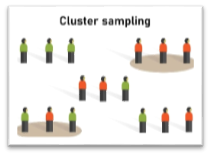
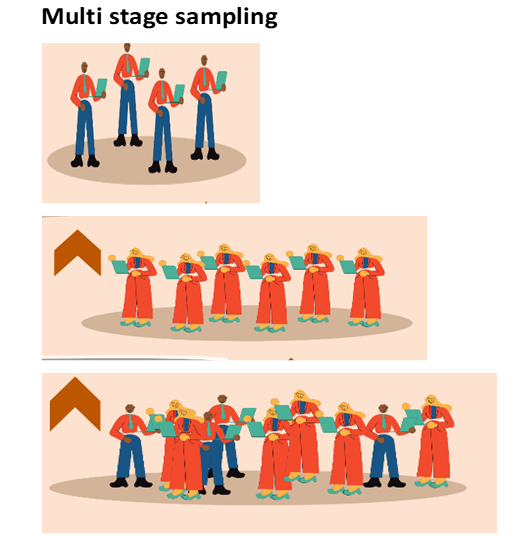
Different methods of sampling include simple random sampling, systematic sampling, stratified sampling, cluster sampling, and multistage sampling.


9. Execution (Implementation) of a survey
The execution of a survey requires as much care as its planning. During the planning period, interviewers and interpreters are trained on how to use the questionnaire, and their techniques for anthropometric measurement or laboratory work are standardized. Once they begin fieldwork, the organizer should occasionally accompany them to ensure they continue to follow the techniques they were taught. When approaching a new interviewee or household, the interviewer should first introduce themselves. If they have an identification card or letters from authorities, these should be shown. The next step is to explain the purpose of the survey. The interviewer should then ask if it is a convenient time to conduct the interview.
10. Analysis of the results
After the survey, the data should be systematically analyzed to draw conclusions and identify the problems of the area. Statistical methods are essential for contextualizing numerical data, allowing for a better understanding of its meaning. The two primary functions of statistical methods are to summarize data and to make inferences about the data.
11. Writing the report
After the analysis and interpretation of survey data, a comprehensive report should be written based on the survey findings. Necessary recommendations should be included. The report should be submitted to the concerned authorities for their attention.
12. Feedback to the community
Feedback must be provided to every level of the hierarchy involved, from the highest government officials to individual community members where the survey was conducted. It is important to tailor the reports to the educational level of the recipients. Objective reporting should be combined with subjective discussion to foster dialogue between the speaker and the audience. The reported results are useful for corrective actions and improvements within the community. The community will expect some form of acknowledgment for their cooperation, and the feedback should help determine what this should be. The confidentiality of individual data must always be respected, so feedback should be presented in terms of population rates and should not refer to individuals.
13. Initial health action after community diagnosis
Establishing priorities involves using a systematic method to assign greater or lesser importance to various diseases, problems, and interventions. Before prioritizing, it is essential to differentiate between the community’s “felt needs” (perceived needs), “real needs” (priority needs), and the types of health problems present.
Just as clinical diagnosis leads to treatment, community diagnosis should lead to health action. Action implies a health program initiated by the survey team to provide appropriate services to the community. This could include an action program such as community immunization, health education, or stimulating the community to organize their primary health care or protect their water sources. This action may initially be short-term but should also include a long-term component.
Priority setting of community health problem
Criteria in prioritization
- Nature of the condition or problem presented- the problems are classified as health status, health resources, or health related problems.
- Magnitude of the problem- the severity of the problem which can be measured in terms of the proportion of the population affected by the problem.
- Modifiability of the problem- the probability of reducing, controlling or eradicating the problem.
- Preventive potential- the probability of controlling or reducing the effects posed by the problem.
- Social concern- the perception of the population or the community as they are affected by the problem and their readiness to act on the problem.
Characteristics of health action
- Preventive: Actions aimed at preventing disease or health issues before they occur, such as vaccinations and health education.
- Promotive: Efforts to promote overall well-being and healthy behaviors, such as fitness programs and nutrition counseling.
- Curative: Actions focused on treating diseases or health issues to cure or manage them, like surgeries or medication.
- Rehabilitative: Activities that help restore or improve function after illness or injury, including physical therapy and occupational therapy.
Various levels of Health Action
Health actions can be implemented at different levels
Individual level:
- Personal Health practices: Adopting healthy lifestyle choices, such as balanced diet, regular exercise, and avoiding harmful behaviors like smoking.
- Self-care: Managing minor health issues at home, taking medications as prescribed, and monitoring one’s own health status.
Family Level:
- Health education: Educating family members about health practices, disease prevention, and the importance of regular medical check-ups.
- Support systems: Providing emotional and practical support to family members dealing with health issues.
Community level:
- Community Health programs: Organizing health camps, vaccination and health awareness campaigns.
- Environmental Health measures: Ensuring clean water supply, proper waste disposal, and reducing environmental pollution.
14. Analysis and Interpretation of Results
- Data Analysis involves managing the data and applying statistical methods.
- Data Interpretation is the process of drawing inferences from the collected information and searching for broader meaning in the research findings.
- Data Presentation serves several purposes:
- To facilitate a clear understanding of the data.
- To link the findings with other studies.
- To maintain continuity in research.
- To guide future research.
Data processing
Data processing involves the systematic collection, analysis, summarization, and reporting of data. This process can be carried out manually by hand, mechanically by machines, or electronically using devices, depending on factors such as the size, type, timing, and cost considerations. Raw data collected needs to be processed to extract meaningful insights. It is essential that data is uniform, consistent, accurate, and complete, with unnecessary information discarded.
Data coding- labeling the responses in a unique and abbreviated way.
Data editing- examining the collected data to detect errors or omissions
Data classification
- Complex to simple
- Heterogeneous to homogenous
- Voluminous to definite form
- Make raw data useful for tabulation, analysis and interpretation.
15. Analyzed data presentation
I. Table
Classification of tables according to number of variable
- One-way table (contain one variable)
- Two-way table (contain two variables)
- Multiple way table (more than two variables)
- Master table (several variables)
- Dummy table
II. Diagrammatic representation
Bar diagram
- Simple bar diagram
- Multiple bar diagram
- Subdivided bar diagram
- Pie diagram
- Pictogram
- Cartogram
Additional link: Click here

You May Also Like

Hospital Waste Management/Health Care Waste Management

Changing concept of health